
Homes, basements and shops along the Ohio River
Spray Foam Insulation in Evansville, IN
Warmer floors in January, cooler rooms in July, with every area priced in writing before we start.
- Free on-site estimates
- Written quote with material, thickness and R-value for every area
- Basements, crawl spaces and attics checked for moisture and leaks first
Insulating for Two Seasons
Spray foam insulation in Evansville has to handle both ends of the calendar. Wikipedia's climate summary for the city lists January averaging 32.5F and July 78.0F, with about 41 days a year at or above 90F, a record high of 111F, about 45 inches of rain and close to 12 inches of snow a season. That means a long heating season and a long cooling season, and a house that leaks air pays for it in both. We seal those leaks and insulate the spaces that need it, using open-cell or closed-cell spray foam where it fits and blown-in insulation where that does the job for less.
What Indiana's code asks for
The 2020 Indiana Residential Code, based on the 2018 IRC, took effect on December 26, 2019. The Insulation Institute's summary of its energy provisions lists these Climate Zone 4 targets: R-38 for ceilings, R-15 for wood-frame walls, and R-13 cavity or R-10 continuous for basement walls and crawl space walls. ENERGY STAR sets the bar higher for existing homes in Zone 4A: R-60 in an attic with no insulation, or an added R-49 where 3 to 4 inches are already there. Many older Evansville attics have a fraction of that.
An older housing stock
Evansville is an old river city. It was founded in 1812, incorporated in 1817, and grew fast in the late 1800s on river trade, coal and hardwood furniture. Point2Homes' summary of census data puts the city's median build year at 1961, with about 22% of homes built before 1940 and another 11% in the 1940s. About 64% of housing units are detached single-family houses.
Those numbers explain a lot of what we see. Pre-war houses with balloon framing, open wall cavities that run from basement to attic, and little or no wall insulation. Post-war bungalows and ranches with shallow attics, basements or crawl spaces, and rim joists that have never been sealed. Fixing the rim joist and the attic floor in those houses changes how they feel more than almost anything else.
Closed cell vs open cell
Closed-cell foam is dense and rigid. HomeGuide rates it at R-5 to R-7 per inch, and at typical thickness it slows vapor and does not soak up water. That makes it the usual choice for rim joists, basement walls, crawl space walls and steel buildings. Open-cell foam is light and expands more, rated R-3.5 to R-3.7 per inch, and seals air very well; it suits interior walls, above-grade cavities and some rooflines where the moisture plan is handled separately.
Foam is not always the best value. On an open attic floor, sealing the bypasses and then blowing cellulose or fiberglass to R-49 or more usually costs much less than foam and does the job well. We say so when that applies.
Spray foam insulation cost
HomeGuide's 2026 guide puts installed spray foam at $1.50 to $5.00 per square foot: $1.50 to $3.50 for open-cell and $3.00 to $5.00 for closed-cell. It lists rim joists at $2,000 to $2,500, an attic at $3,000 to $8,000, a crawl space at $2,000 to $4,000 and a whole house at $8,000 to $20,000, and notes that many companies set a minimum of $1,000 to $2,000 or more. Blown-in insulation runs $1.00 to $2.80 per square foot. Those national figures help with budgeting; access, foam type, thickness and removal set the real cost. The written estimate after our visit is the price.
Questions to ask insulation contractors
When you compare spray foam insulation contractors and insulation companies in Evansville, ask a few things. What will be sealed before anything is insulated? Which foam goes where, at what thickness and R-value? How will they handle a damp basement wall or crawl space? How long does the house need to be empty (HomeGuide says at least 24 hours)? Is the price broken out by area? Our written quotes answer each of those.
Rebates to check
CenterPoint Energy's Indiana residential rebate program has offered attic insulation rebates through program-approved contractors; its 2024 fact sheet listed up to $450, and the program kept a list of approved insulation partners in October 2025. Terms change every year, so check the current program and whether your installer qualifies before you count on a rebate.
Timing
Wikipedia lists Evansville's average last spring freeze as April 7 and first fall freeze as October 26. Basements and heated spaces can be sprayed any time of year. Attics and unheated buildings are easier outside the hottest and coldest weeks, and fall books up as people try to get ahead of winter.
Common Questions
How much should I expect to pay for spray foam insulation?
HomeGuide's 2026 guide lists $1.50 to $5.00 per square foot installed, with rim joists at $2,000 to $2,500 and an attic at $3,000 to $8,000. Size, access, foam type and removal change the total. The written estimate after our visit is the price.
Why is spray foam insulation now a red flag?
Most concerns trace back to bad installs: foam sprayed too thick at once, foam over a leak, or a sealed attic or crawl space planned without thinking about moisture and the HVAC system. Lenders and inspectors also ask about foam that hides roof sheathing. A clear plan, the right thickness and paperwork showing what was installed answer most of those questions.
Can mold penetrate spray foam?
Mold needs moisture and food. Cured foam is not a good food source, but mold can grow on dust or on wood next to foam if water gets in. Closed-cell foam resists water; open-cell can hold some. The real protection is keeping water out: fix leaks and drainage before insulating.
What is cheaper, spray foam or regular insulation?
Per square foot, blown-in fiberglass or cellulose is cheaper: HomeGuide lists $1.00 to $2.80 per square foot versus $1.50 to $5.00 for foam. Foam costs more but seals air in the same step, which matters on rim joists, basement walls and steel. We recommend each where it pays.
What R-value should an Evansville attic have?
Indiana's code summary lists R-38 for ceilings in Climate Zone 4. ENERGY STAR recommends R-60 for an uninsulated Zone 4A attic, or adding R-49 to one with 3 to 4 inches.
Should I insulate my rim joist?
In most Evansville houses with a basement or crawl space, yes. The rim joist is often bare or stuffed with loose fiberglass and leaks cold air all winter. Closed-cell foam seals and insulates it in one step; HomeGuide lists the job at $2,000 to $2,500.
What We Do
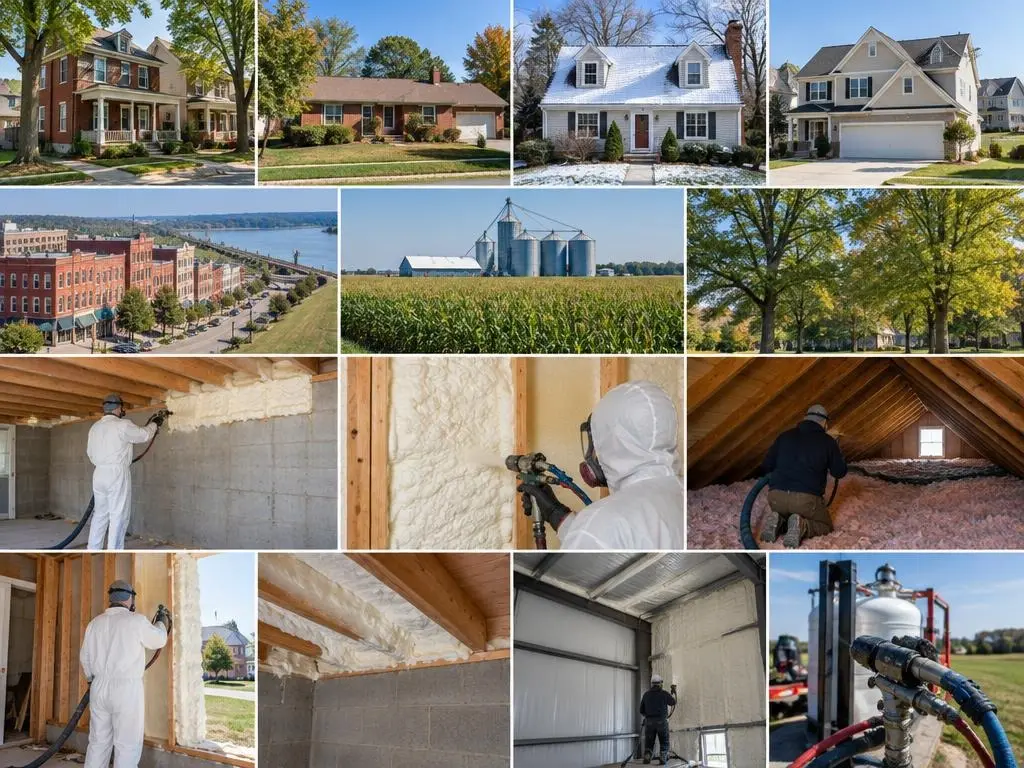
Six kinds of insulation work, matched to each part of a Tri-State house or outbuilding, from the rim joist up to the attic.
Spray Foam Insulation
Closed-cell and open-cell foam that insulates and seals air together, for rim joists, walls, rooflines and steel buildings.
Learn more →Attic Insulation & Air Sealing
Seal the attic bypasses that leak heat both ways, then bring the attic to Zone 4A depth.
Learn more →Basement & Rim Joist Insulation
Closed-cell foam on rim joists and basement walls to stop perimeter drafts and warm up cold floors.
Learn more →Crawl Space Insulation & Encapsulation
Vapor barrier, sealed vents and insulated walls to dry out and warm up a Tri-State crawl space.
Learn more →Pole Barn & Shop Insulation
Closed-cell foam for pole barns, steel shops and garages that drip in winter and bake in summer.
Learn more →Blown-In Insulation
Cellulose or fiberglass blown to depth in attics and dense-packed into closed walls of older homes.
Learn more →Tri-State Towns We Cover
We work in Evansville and across the Tri-State: Newburgh, Chandler and Boonville in Warrick County; Darmstadt in northern Vanderburgh County; Mount Vernon and Poseyville in Posey County; Princeton, Haubstadt and Fort Branch in Gibson County; Rockport in Spencer County; and Henderson and Owensboro across the river in Kentucky. River towns hold older houses and basements with flood histories. Gibson and Posey county towns have more farmhouses and pole barns. Each town page covers what stands out there.
- Spray Foam Insulation in Evansville, IN
- Spray Foam Insulation in Newburgh, IN
- Spray Foam Insulation in Chandler, IN
- Spray Foam Insulation in Boonville, IN
- Spray Foam Insulation in Darmstadt, IN
- Spray Foam Insulation in Henderson, KY
- Spray Foam Insulation in Mount Vernon, IN
- Spray Foam Insulation in Princeton, IN
- Spray Foam Insulation in Haubstadt, IN
- Spray Foam Insulation in Fort Branch, IN
- Spray Foam Insulation in Poseyville, IN
- Spray Foam Insulation in Rockport, IN
- Spray Foam Insulation in Owensboro, KY
Why Homeowners Call Spray Foam Insulation Evansville
We look first
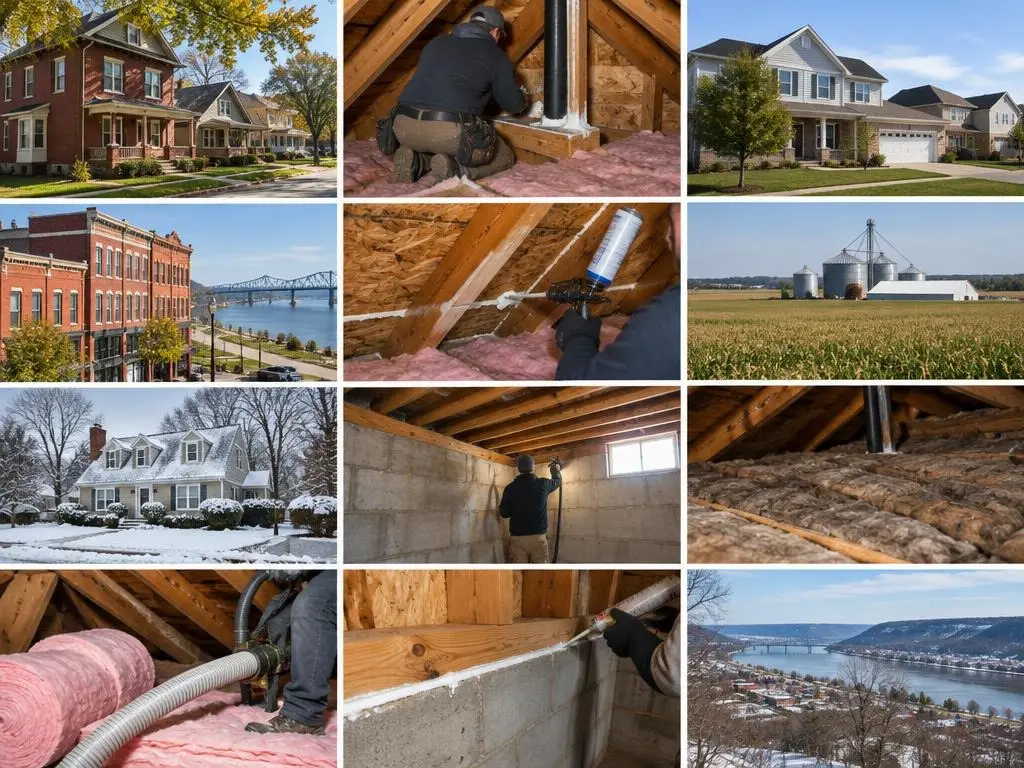
Every quote follows a visit to the attic, basement, crawl space or building.
Moisture before insulation
Damp walls, wet crawl spaces and leaks are flagged and handled first.
The right material per area
Closed-cell, open-cell, cellulose or fiberglass, chosen for the surface, with the reason written down.
Quotes you can compare
Each area shows material, thickness or depth, R-value and price.
Get a Written Insulation Quote in Evansville
We come out, check the attic and what is below the floor, and send a written price with the material and R-value for each area.