
Pole barns, shops and garages
Pole Barn & Shop Insulation in Evansville, IN
Foam on the steel that stops the drip and lets a heater or AC actually keep up.
- Free on-site estimates
- Written quote with material, thickness and R-value for every area
- Basements, crawl spaces and attics checked for moisture and leaks first
Steel Buildings in Farm Country
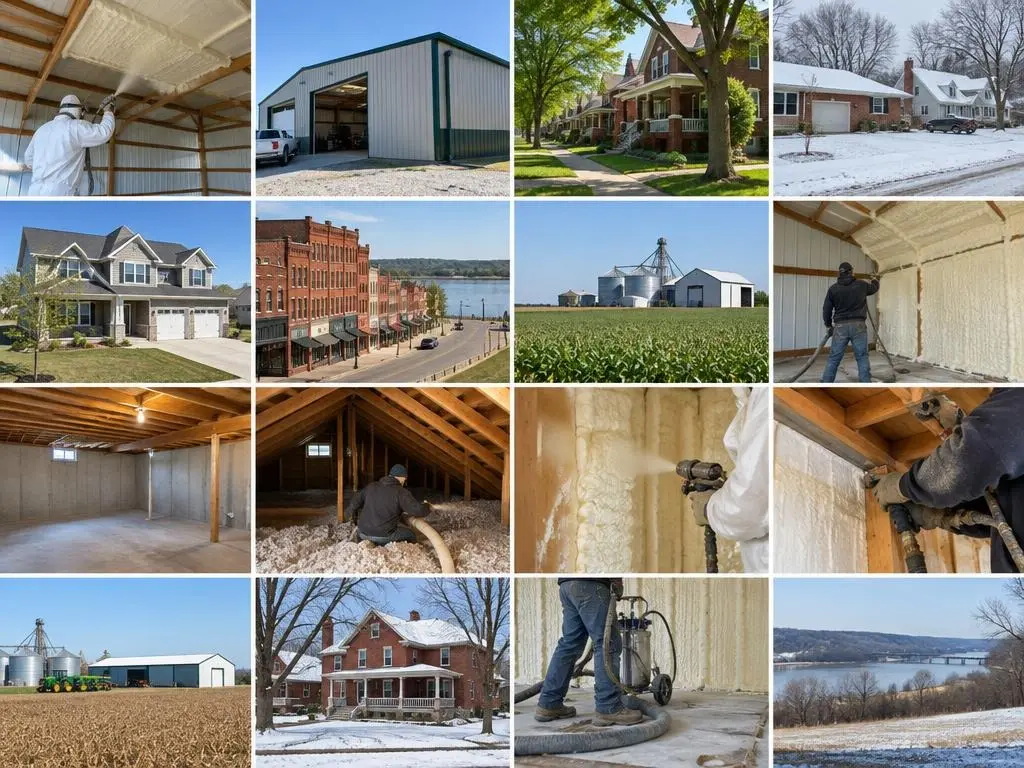
Pole barn and shop insulation around Evansville handles two problems at once. In winter, warm, moist air inside the building touches cold steel and condenses, dripping on vehicles, equipment, hay and tools. In summer, the sun heats the steel and the building turns into an oven. Spray foam bonded to the panels deals with both. Gibson, Posey and Warrick counties are full of pole barns and steel shops, and this is one of our most common jobs outside the city.
Why closed-cell
Closed-cell foam bonds directly to steel panels, purlins and girts and cures rigid. HomeGuide rates it at R-5 to R-7 per inch, and at normal thickness it acts as its own vapor retarder. With no gaps between foam and steel, warm air cannot reach the cold metal, so the drip stops. It also stiffens thin panels a little and quiets rain and hail.
Sizing the job to the use
- Equipment and hay storage: enough roof foam to stop condensation
- Heated workshop or garage: more foam on roof and walls, plus sealed doors and eaves
- Year-round shop or office: foam sized to the heating and cooling equipment
- Barndominium or living space: foam to residential code targets
Tell us how you use the building and we write a plan to match.
Doors and eaves
Foam on the panels does little if air pours in around big sliding or overhead doors, under the eaves, or where the roof meets the walls. We seal what we can at the eaves and closures and point out doors that need new seals.
Temperature and timing
Foam and steel need to be in a working temperature range. In a Tri-State winter that may mean heating the building beforehand or picking a milder week. Spring and fall are the easiest times. HomeGuide advises staying out of sprayed areas for at least 24 hours.
Code and fire protection
Indiana's building rules treat farm buildings differently from homes and commercial buildings, and foam inside occupied buildings generally needs a thermal or ignition barrier unless the product is approved for exposure. If the building will be a heated shop, a business or living space, check with your county building office, and ask any installer which product and covering they plan.
Send us the building's size, wall height, roof type and how you use it. We will look and write up a quote. Get a free estimate
Buildings We Insulate
Common outbuildings around the Tri-State and how we usually treat them.
Pole barns
Roof foam to stop condensation on equipment and hay.
Heated shops
Roof and wall foam with sealed doors and eaves.
Detached garages
Foam so a heater or mini-split can keep up.
Barndominiums
Foam to residential targets in a steel shell.
Ag and equipment buildings
Roof foam sized to stop the drip.
Eaves and closures
Sealing air gaps at the roof-wall joint.
Published Costs That Apply to Pole Barns and Shops
| Job | Range and source |
|---|---|
| Closed-cell spray foam, installed | $3.00 to $5.00 per sq ft (HomeGuide) |
| Open-cell spray foam, installed | $1.50 to $3.50 per sq ft (HomeGuide) |
| New construction spray foam | $2.75 to $6.50 per sq ft (Fixr) |
| About 1,000 sq ft of foam | $1,500 to $5,000 (HomeGuide) |
| Blown-in, per sq ft | $1.00 to $2.80 (HomeGuide); $1.65 to $3.80 (Fixr) |
| Typical spray foam minimum | $1,000 to $2,000+ (HomeGuide) |
General foam and blown-in ranges from HomeGuide (2026) and Fixr (2025), not specific to pole barns. Height, steel profile, thickness and coatings change the cost. We measure, and the written estimate is your price.
How a Building Job Runs
1. Look and measure
Steel, roof, doors and use checked.
2. Quote
Roof and walls priced with thickness and R-value.
3. Prep
Steel cleaned and dried; contents moved or covered; heat if needed.
4. Spray
Foam in passes to planned thickness.
5. Finish
Eaves sealed where planned; cleanup.
Why Choose Us for Pole Barn & Shop Insulation
Sized to the use
A hay barn and a heated shop get different plans.
Doors and eaves included
We look at the leaks, not just the panels.
Coatings discussed
We say up front what covering a building may need.
Pole Barn & Shop Insulation Questions
How thick should foam be in a pole barn?
To stop condensation, a modest layer of closed-cell on the roof steel is often enough. A heated shop needs more. Thickness and R-value are on the quote.
Can you spray in winter?
Yes, if the building and steel can be brought into the working temperature range, often with temporary heat.
Will foam stop my roof from dripping?
Closed-cell bonded to the steel keeps warm, moist air off the cold metal, which is what causes the drip.
Do I need a permit?
It depends on the building and use. Check with your county building office.
Pole Barn & Shop Insulation Service Areas
- Spray Foam Insulation in Evansville, IN
- Spray Foam Insulation in Newburgh, IN
- Spray Foam Insulation in Chandler, IN
- Spray Foam Insulation in Boonville, IN
- Spray Foam Insulation in Darmstadt, IN
- Spray Foam Insulation in Henderson, KY
- Spray Foam Insulation in Mount Vernon, IN
- Spray Foam Insulation in Princeton, IN
- Spray Foam Insulation in Haubstadt, IN
- Spray Foam Insulation in Fort Branch, IN
- Spray Foam Insulation in Poseyville, IN
- Spray Foam Insulation in Rockport, IN
- Spray Foam Insulation in Owensboro, KY
Get a Pole Barn & Shop Insulation Estimate
Tell us the building size and how you use it. We will look and send a written quote.