
Closed-cell and open-cell foam
Spray Foam Insulation in Evansville, IN
Closed-cell where cold and damp meet the house, open-cell where air sealing and sound matter most.
- Free on-site estimates
- Written quote with material, thickness and R-value for every area
- Basements, crawl spaces and attics checked for moisture and leaks first
Choosing Foam for a Four-Season House
Spray foam insulation in Evansville earns its cost where heat and air leak fastest: rim joists, basement and crawl space walls, kneewalls, cathedral ceilings and steel buildings. It sprays on as a liquid, expands into every gap and cures in place, so one layer insulates and seals. In a city that sees both 90F summer days and January lows well below freezing, that air seal matters in both seasons. Two foams do two different jobs.
Closed cell vs open cell
Closed-cell foam cures hard and dense. HomeGuide rates it at R-5 to R-7 per inch; at normal thickness it slows vapor and does not absorb water, and it stiffens the surface it bonds to. Open-cell foam cures soft and expands more, rated R-3.5 to R-3.7 per inch. It seals air and dampens sound well but lets vapor through, so in a cold-winter climate it usually needs a vapor retarder on the warm side or an assembly that can dry.
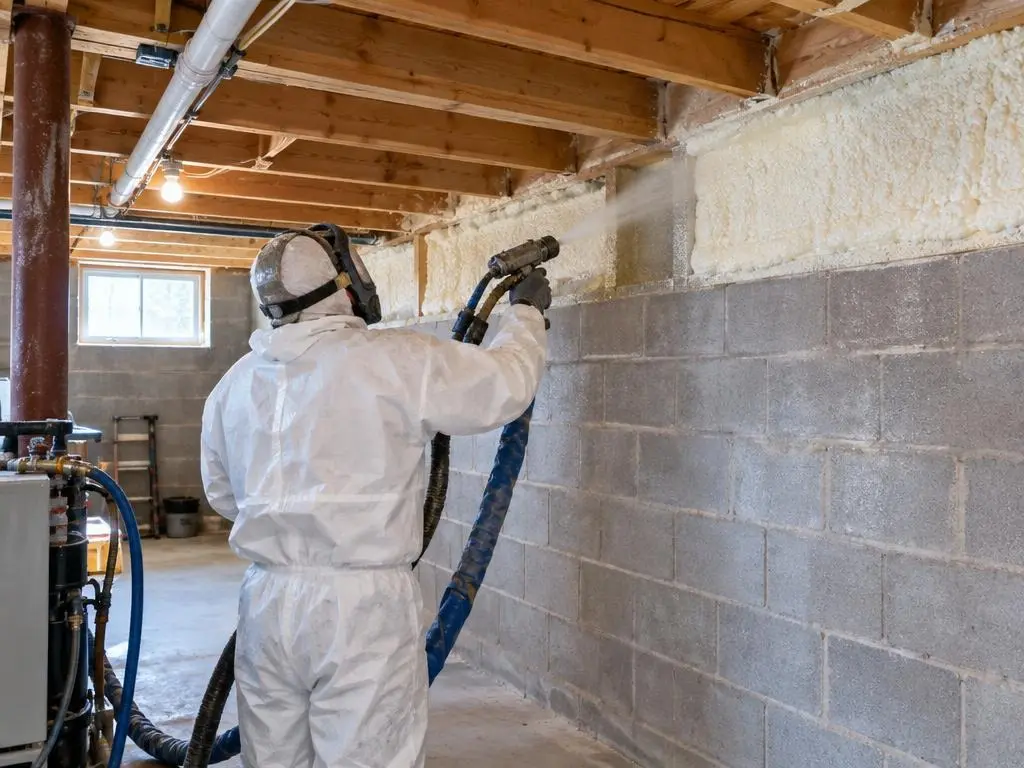
In the Tri-State that sends closed-cell to the cold, damp, tight spots: rim joists, basement and crawl space walls, roof decks without room for vent channels, and pole barn steel. Open-cell fits interior walls, above-grade cavities and some attic rooflines where the moisture plan is handled.
Code targets
The Insulation Institute's summary of the 2020 Indiana Residential Code lists Climate Zone 4 targets of R-38 for ceilings, R-15 for wood-frame walls, and R-13 cavity or R-10 continuous for basement and crawl space walls. In a 2x4 wall, closed-cell reaches R-15 or more in about three inches. On a basement wall, a couple of inches of closed-cell meets the continuous target. We write the planned thickness and R-value on the quote.
Where foam goes in an Evansville house
The rim joist is the most common foam job here. It runs around the whole house on top of the foundation, is usually bare wood or loosely stuffed fiberglass, and lets cold air into the basement or crawl space all winter. Two to three inches of closed-cell seals it in one pass.
Above that, we foam kneewalls and the short attic floors behind them in story-and-a-half houses, floors over garages, cantilevers, and attic bypasses before loose fill goes on top. In older homes with balloon framing, wall cavities often run open from the basement to the attic and act as chimneys for warm air; foam is the practical way to block them at the top and bottom.
Where foam is not the answer
Foam does not fix leaks. Roof, plumbing or foundation water gets fixed first. Foam should not cover knob-and-tube wiring or vermiculite that may contain asbestos until those are checked. And on a wide, open attic floor, blown-in insulation usually reaches R-49 or R-60 for less. We say so when that is the case.
Prep, temperature and cure
We cover floors and belongings, mask what needs it, and set up ventilation. Foam and the surface need to be within a working temperature range, so for unheated spaces in winter we add heat or schedule a milder day. HomeGuide advises staying out for at least 24 hours while foam cures. Cured foam does not settle, so the thickness we install stays.
Tell us which spaces you are thinking about and what you have noticed. We will look, explain where foam pays, and send a written price. Get a free estimate
Where We Spray Foam
The spaces we foam most often in Tri-State homes, and the foam we usually pick.
Closed-cell foam
R-5 to R-7 per inch (HomeGuide), slows vapor; rim joists, foundation walls, steel.
Open-cell foam
R-3.5 to R-3.7 per inch, seals air and quiets sound; interior and above-grade cavities.
Rim joists
Foam on the band board above the foundation to stop perimeter drafts.
Kneewalls and bonus rooms
Sealing walls and floors around upstairs rooms and rooms over garages.
Cathedral ceilings and roof decks
Closed-cell where there is no attic or no room for vent channels.
Remodels and additions
Open stud bays sprayed to the Zone 4 wall target.
Pole barns and shops
Foam on steel to insulate and stop condensation.
Published Spray Foam Insulation Costs
| Job | Range and source |
|---|---|
| Spray foam, installed | $1.50 to $5.00 per sq ft (HomeGuide) |
| Open-cell / closed-cell | $1.50 to $3.50 / $3.00 to $5.00 per sq ft (HomeGuide) |
| About 1,000 sq ft | $1,500 to $5,000 (HomeGuide); $3,150 to $7,500 existing home (Fixr) |
| Existing walls / new construction | $3.15 to $7.50 / $2.75 to $6.50 per sq ft (Fixr) |
| Whole house | $8,000 to $20,000 (HomeGuide); $10,000 to $30,000 (Fixr) |
| Typical job minimum | $1,000 to $2,000+ (HomeGuide) |
National figures from HomeGuide (2026) and Fixr (2025). Foam type, thickness, access and prep shift the number, and small jobs often hit a minimum. The figure on your written estimate is what you pay.
How a Spray Foam Job Runs
1. Visit
We check each space for leaks, damp wood, wiring and old insulation, and measure.
2. Written quote
Foam type, thickness, R-value and price for every area.
3. Prep
Cover, mask, ventilate, and confirm the space is warm enough to spray.
4. Spray and trim
Foam goes on in passes to the planned thickness.
5. Walk-through
Cleanup, a look at the work and the return time.
Why Choose Us for Spray Foam Insulation
Foam only where it pays
If loose fill or sealing does the job for less, we say so.
Thickness in writing
Thickness and R-value are on the quote for fair comparison.
Problems flagged first
Leaks, old wiring and suspect insulation are pointed out before anything is covered.
Spray Foam Insulation Questions
Is closed-cell worth the extra cost in Indiana?
On rim joists, foundation walls, crawl space walls and steel buildings, usually yes. In interior walls or above-grade cavities, open-cell often does the job for less.
Can spray foam be installed in winter?
In heated basements, yes. Cold attics and unheated buildings may need temporary heat or a milder day.
How long do we stay out after spraying?
HomeGuide advises at least 24 hours.
Does spray foam stop moisture?
Closed-cell slows vapor and keeps warm, moist air off cold surfaces. It does not fix leaks and is not waterproofing.

Spray Foam Insulation Service Areas
- Spray Foam Insulation in Evansville, IN
- Spray Foam Insulation in Newburgh, IN
- Spray Foam Insulation in Chandler, IN
- Spray Foam Insulation in Boonville, IN
- Spray Foam Insulation in Darmstadt, IN
- Spray Foam Insulation in Henderson, KY
- Spray Foam Insulation in Mount Vernon, IN
- Spray Foam Insulation in Princeton, IN
- Spray Foam Insulation in Haubstadt, IN
- Spray Foam Insulation in Fort Branch, IN
- Spray Foam Insulation in Poseyville, IN
- Spray Foam Insulation in Rockport, IN
- Spray Foam Insulation in Owensboro, KY
Get a Spray Foam Insulation Estimate
Tell us the spaces and what you have noticed. We will look and send a written foam plan and price.