
The bottom of the house
Basement & Rim Joist Insulation in Evansville, IN
Seal the band of wood where cold air pours in, and insulate basement walls before you finish them.
- Free on-site estimates
- Written quote with material, thickness and R-value for every area
- Basements, crawl spaces and attics checked for moisture and leaks first
Where Cold Air Gets In
Basement and rim joist insulation in Evansville goes after the leak most houses never deal with. The rim joist is the band of wood that sits on top of the foundation wall and holds up the floor. It runs around the whole house, it is usually bare or loosely stuffed with fiberglass, and in winter it lets cold air into the basement along every foot of the perimeter. Floors above stay cold, and the furnace runs longer. Sealing and insulating the rim is one of the cheapest, most effective jobs in an older house.
Closed-cell on the rim
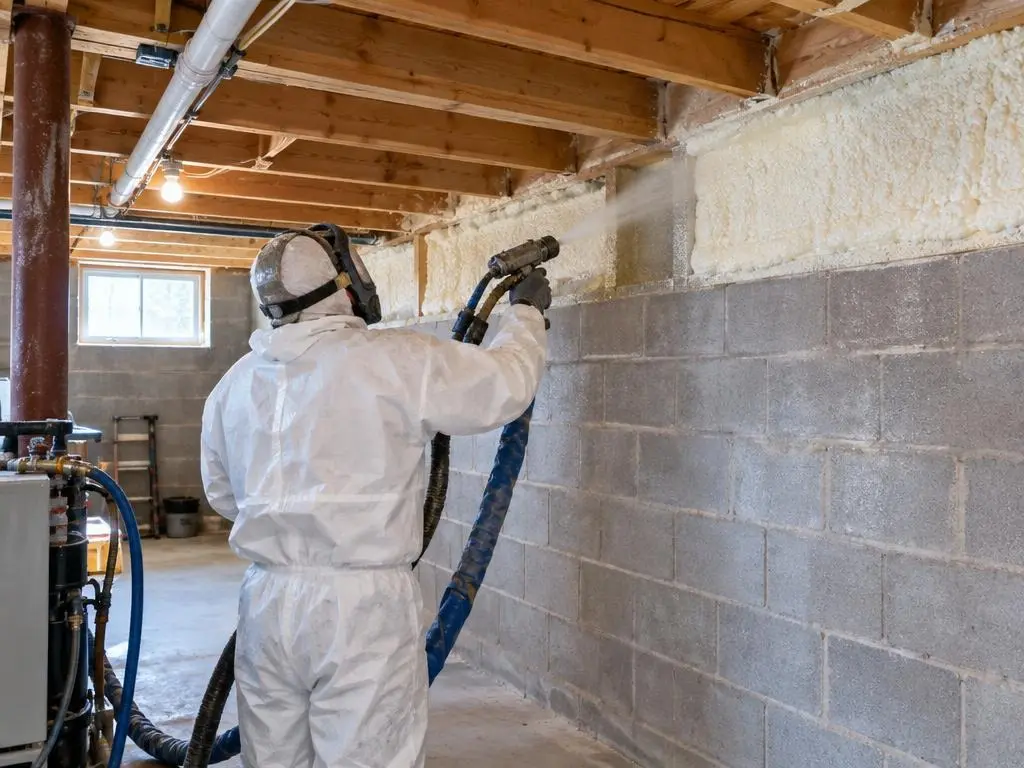
Two to three inches of closed-cell spray foam sprayed onto the rim joist and the sill plate seals the gaps, insulates the wood, and keeps warm, moist indoor air from condensing on the cold band board. HomeGuide rates closed-cell at R-5 to R-7 per inch and lists a typical rim joist job at $2,000 to $2,500. Fiberglass stuffed into the rim does little because air passes through it, and it can hold moisture against the wood.
Basement walls
The Insulation Institute's summary of the 2020 Indiana Residential Code lists R-13 cavity or R-10 continuous insulation for basement walls in Climate Zone 4. Closed-cell foam sprayed directly on the concrete or block meets the continuous target in about two inches, bonds to the wall, and does not trap water against it the way fiberglass batts against concrete can. If you plan to finish the basement, insulating the walls and rim before framing goes up is the time to do it.
Water comes first
A basement wall that seeps after rain, has efflorescence, or shows active cracks needs the water dealt with before insulation goes on. Evansville's 1937 Ohio River flood covered about 500 city blocks, and the city has levees for a reason. Many homes on low ground deal with damp basements. Grading, gutters and drainage come first. Foam will not stop water coming through a wall.
Older foundations
Pre-war Evansville homes, about 22% of the city's housing in Point2Homes' census summary, often have stone or brick foundations and rubble walls that are uneven and can wick moisture. Those walls need a careful plan. Sometimes the right move is just sealing the rim and insulating the floor above, rather than covering an old wall that needs to breathe.
Fire protection
Foam in a basement generally needs a thermal barrier such as drywall if the space is finished or occupied, unless the product is approved for exposure. Ask your installer which product they plan and what covering it needs.
Tell us whether the basement is finished, unfinished or about to be finished, and we will look and send a written quote. Get a free estimate
What Basement Work Covers
Where we work below the main floor in Tri-State homes.
Rim joists and sill plates
Closed-cell sealed and insulated around the perimeter.
Basement walls
Closed-cell to the Zone 4 continuous target before finishing.
Walkout and partial basements
Walls, rims and any framed knee walls.
Cantilevers and floor overhangs
Foam where floors stick out past the foundation.
Garage-to-basement walls
Sealing between an attached garage and the basement.
Published Rim Joist and Basement Foam Costs
| Job | Range and source |
|---|---|
| Rim joists, spray foam | $2,000 to $2,500 (HomeGuide) |
| Closed-cell, installed | $3.00 to $5.00 per sq ft (HomeGuide) |
| Open-cell, installed | $1.50 to $3.50 per sq ft (HomeGuide) |
| Existing walls / new construction | $3.15 to $7.50 / $2.75 to $6.50 per sq ft (Fixr) |
| About 1,000 sq ft of foam | $1,500 to $5,000 (HomeGuide) |
| Typical spray foam minimum | $1,000 to $2,000+ (HomeGuide) |
National numbers from HomeGuide (2026) and Fixr (2025). Linear feet of rim, wall height, access and prep decide your total. The written estimate we give you is the price.
How a Basement Job Runs
1. Inspect
We look for water, cracks, wiring and the rim's condition.
2. Quote
Rim and walls priced separately with thickness and R-value.
3. Prep
Old fiberglass removed from the rim; area cleared and covered.
4. Spray
Closed-cell applied to rim and walls.
5. Review
Cleanup and a note on any covering the foam needs.
Why Choose Us for Basement & Rim Joist Insulation
Water flagged first
We do not foam over a wall that is actively leaking.
Old foundations respected
Stone and brick walls get a plan that suits them.
Rim done right
Fiberglass comes out so foam bonds directly to the wood.
Basement & Rim Joist Insulation Questions
Is rim joist insulation worth it?
In most older houses, yes. It stops perimeter drafts and warms floors. HomeGuide lists it at $2,000 to $2,500.
Do I need to remove the fiberglass in my rim joists?
Yes, foam needs to bond directly to the wood.
Can foam go on a damp basement wall?
Not until the water problem is solved.
Does basement foam need drywall over it?
In finished or occupied spaces it generally needs a thermal barrier unless the product is approved for exposure.

Basement & Rim Joist Insulation Service Areas
- Spray Foam Insulation in Evansville, IN
- Spray Foam Insulation in Newburgh, IN
- Spray Foam Insulation in Chandler, IN
- Spray Foam Insulation in Boonville, IN
- Spray Foam Insulation in Darmstadt, IN
- Spray Foam Insulation in Henderson, KY
- Spray Foam Insulation in Mount Vernon, IN
- Spray Foam Insulation in Princeton, IN
- Spray Foam Insulation in Haubstadt, IN
- Spray Foam Insulation in Fort Branch, IN
- Spray Foam Insulation in Poseyville, IN
- Spray Foam Insulation in Rockport, IN
- Spray Foam Insulation in Owensboro, KY
Get a Basement & Rim Joist Insulation Estimate
Tell us about your basement. We will look and send a written quote.